
Results at a Glance
- MI electric heat trace circuit fully repaired and restored to service
- No impact to operations during live maintenance activities
- Zero recordable incidents, dropped objects, or permit deviations
- Reduced work-at-height exposure compared to traditional scaffolding
- Insulation reinstated to original specification within the approved work window
- Approximately 56% cost reduction compared to conventional access methods
The Challenge
The identified EHT failure on circuit 21-ET(AG2004)-10 posed a risk to process reliability, particularly during cold conditions where loss of heat tracing can lead to freezing, restriction, or integrity damage.
Key challenges included:
- Brownfield work within live operations
- Limited existing anchor points for safe access
- Elevated SIMOPS risk in a congested process area
- The need for timely repair without extended installation activities
Traditional scaffolding would have increased work-at-height exposure, required larger exclusion zones, and extended the duration of on-site activity. A safer, more efficient access solution was required.
The Solution
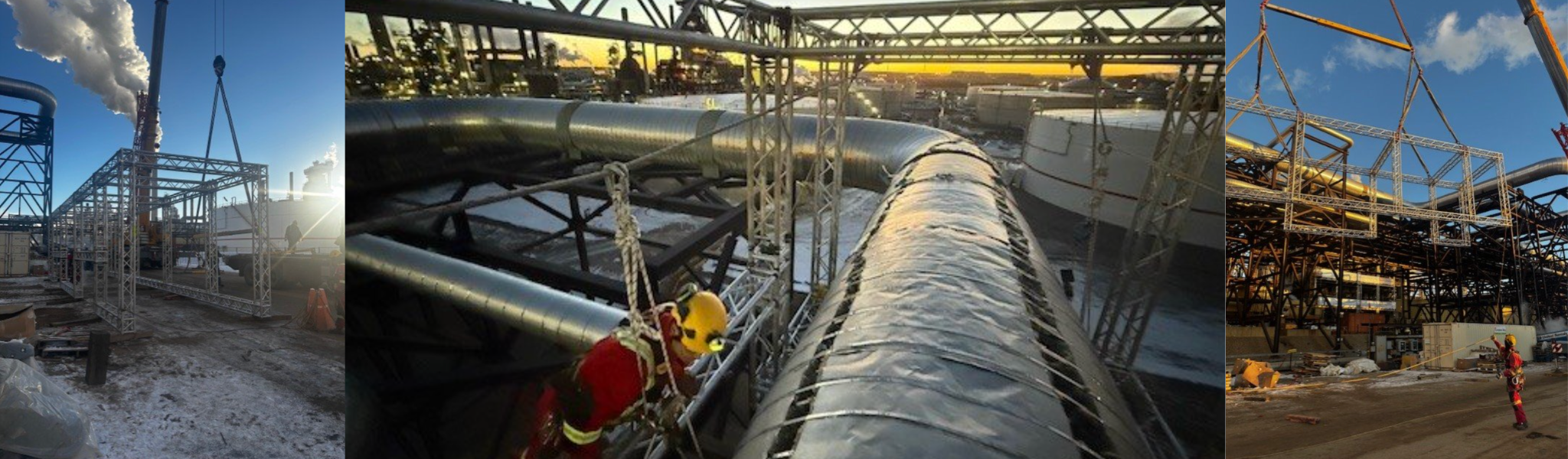
Tacten deployed the MILO truss system, a modular aluminum structure engineered to provide temporary, load-rated anchorage for rope access work where permanent anchor points are unavailable.
The MILO system enabled controlled suspended access with a minimal footprint, allowing technicians to safely reach the tail gas line while reducing installation time and congestion in the operating area. Rope access techniques were used to investigate, repair, and reinstate the affected section of MI electric heat trace.
Scope execution included:
- Mobilization of specialized crew, tools, and MILO components
- Assembly, inspection, and crane-assisted placement of the MILO structure
- Electrical testing to confirm fault location
- Localized insulation removal and MI EHT splice repair
- Post-repair testing to verify circuit integrity
- Full reinstatement of insulation to original specification
Risk-Based Access Approach
Compared to traditional scaffolding, the MILO truss system significantly reduced risk by:
- Lowering total exposure hours at height through rapid installation and removal
- Providing engineered, verified anchorage points
- Minimizing SIMOPS congestion in active process areas
- Reducing manual handling and dropped-object interfaces
- Limiting exclusion zones and operational interference
This approach aligned with site safety expectations while maintaining full compliance with fall protection and access control requirements.
Cost Comparison: MILO Truss vs Conventional Scaffolding
A high-level cost comparison was conducted between conventional scaffolding access and the MILO truss system with rope access. While exact line-item costs varied by service, overall totals demonstrated a significant cost advantage when using the MILO system.
Conventional access methods were estimated at a total project cost of approximately $210,900, driven largely by scaffold erection and dismantling activities, extended exposure hours, and increased congestion within the operating area.
Use of the MILO truss system and rope access reduced the total project cost to approximately $92,300 by minimizing access duration, limiting crane utilization, and reducing insulation and handling requirements.
This approach resulted in an estimated cost savings of $118,600, representing an approximate 56% cost reduction compared to traditional access methods.
Successful Execution & Key Highlights
The repair was completed safely and efficiently within the approved maintenance window, with no impact to ongoing operations. Clear scope definition, strong coordination with Operations, and disciplined permit management ensured smooth execution and eliminated rework or scope creep.
The successful use of the MILO truss system demonstrated the value of alternative access solutions for short-duration, localized maintenance in complex industrial environments, delivering improved safety outcomes while supporting operational continuity.
If you are evaluating alternatives to traditional scaffolding or looking to optimize access for your next maintenance scope, contact our experts today to discuss how the MILO truss system and engineered rope access solutions can support your site.

